Planning to Remove a Tree in Victoria? You Need to Know about Clause 52.37
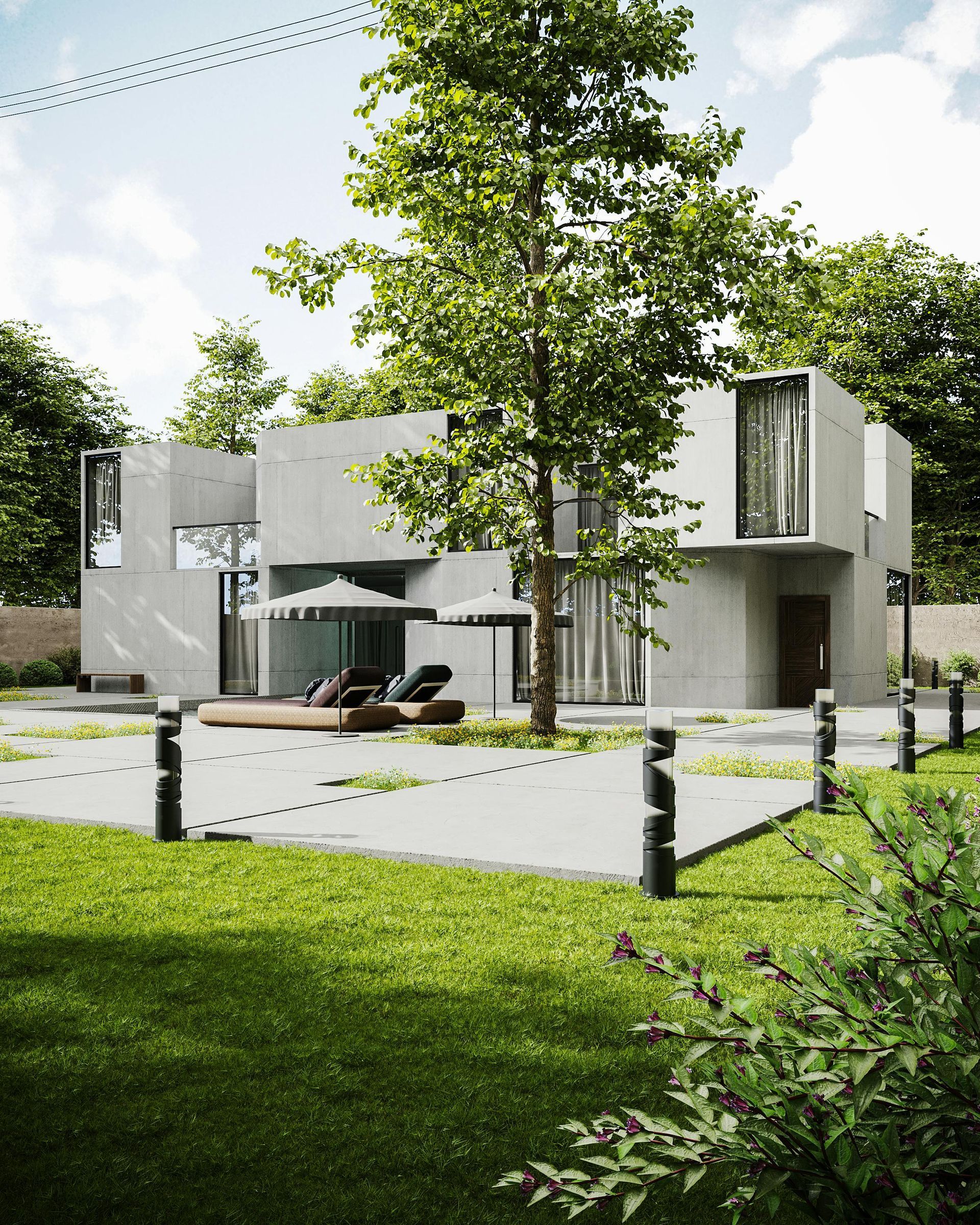
If you’re planning to remove, destroy or lop a tree on your property as of September 15 2025, this is a big change you need to know about.
A new statewide planning provision (Clause 52.37) has officially come into effect introducing new rules for tree removal and canopy cover on residential land across Victoria.
In other words, tree protection laws just got tougher. Many property owners will now need a planning permit to remove, lop ‘canopy trees’. Even if they are on your land.
So what does that mean for you?
Let’s break down what Clause 52.37 actually covers, who it applies to, and how to stay compliant without getting buried in paperwork.
Where Clause 52.37 Applies
The new rules apply to residential land within the following planning zones:
- Mixed Use Zone (MUZ)
- Township Zone (TZ)
- Residential Growth Zone (RGZ)
- General Residential Zone (GRZ)
- Neighbourhood Residential Zone (NRZ)
- Housing Choice and Transport Zone (HCTZ)
If your property sits in one of these zones and you plan to remove or significantly prune a tree, the new permit requirements likely apply.
What Counts as a “Canopy Tree”?
This is where the details matter.
Under Clause 52.37, a “Canopy Tree” is defined as a tree that meets all three of these triggers:
- Height greater than 5 metres
- A single trunk circumference greater than 0.5 metres, measured 1.4 metres above ground level
- Canopy diameter of at least 4 metres
Things to consider
For a tree to be considered a canopy tree, it must tick all three of the above boxes. For example, if a tree is greater than 5m in height, has a canopy diameter of greater than 4m but does not have a single trunk circumference greater than 0.5m. It will not be considered a canopy tree, and will not need a permit to remove, destroy or lop.
Another important note is that a canopy tree needs to be ‘greater’ than the above dimensions. Meaning if a tree is 5m in height exactly it will not need a permit. It needs to be 5.1m in height to tick that box.
When You Need a Permit (and When You Don’t)
Clause 52.37 sets clear rules for when a planning permit is required to remove, lop, or destroy a tree.
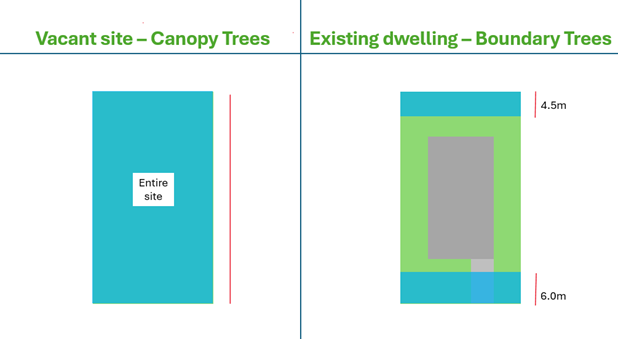
If the site is vacant without a dwelling, you will need a permit to remove destroy or lop a tree that ticks the above 3 boxes anywhere within the site.
If the site has an existing residential dwelling situated on it, you will need a permit to remove, destroy or lop a tree that ticks the above 3 boxes within the front 6m and the rear 4.5m (see below images).
What about corner blocks? Or oddly shaped blocks?
The front of the site is considered to be the side of the block with the shortest street frontage.
In the below example the side facing Waverley St shorter than High St, so Waverley St will be the ‘front’. The rear setback by default is automatically opposite the front.
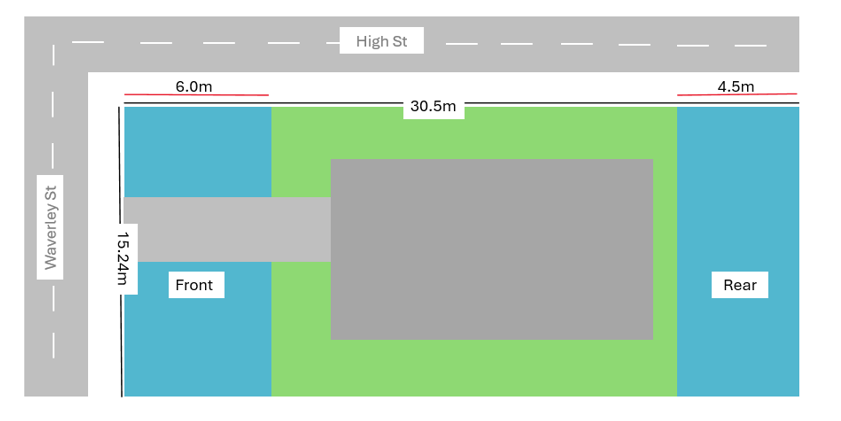
On oddly shaped blocks, it may not be as clear. In situations where it is unclear it is recommended to confirm with the Council.
A permit is not required if:
- The tree does not meet all three canopy triggers
- The tree is dead or listed as a state-declared noxious weed
- It’s being pruned for maintenance (not lopped)
- The works are emergency-related (e.g. after storm damage, or to prevent immediate danger)
Unsure if you need a permit? Our expert consulting arborists can help assess whether your tree meets the criteria and whether your planned works fall under an exemption.
What If You Already Have a Permit?
The government has introduced transitional provisions to make the rollout fair.
Clause 52.37 does not apply if:
- Your building permit was issued before (or within 12 months after) 15 September 2025, and significant design progress was already underway (determined by a suitably qualified person).
- You already hold a planning permit that includes tree removal.
- You lodged your planning application before 15 September 2025; or
- Your land sits within a Development Plan Overlay (DPO) or Incorporated Plan Overlay (IPO) approved before that date.
Essentially, if you were already mid-project when the new clause began, you won’t need to go back and reapply under the new system.
How to Apply for a Tree Removal Permit
All applications under Clause 52.37 go through the planning system, not the building system.
That means your building permit can’t authorise tree removal. You must first obtain a planning permit through either the:
- VicSmart pathway (a 10-day fast-track process for simple cases), or
- Standard planning permit process (suitable for multiple trees).
Applications must include:
- A site plan showing all canopy trees and their locations.
- Photographs identifying each tree proposed for removal or pruning.
- Details of existing and proposed trees, including species and canopy spread.
- The reason for removal (e.g., structural damage, redevelopment, poor health).
- Arborist assessment by an AQF Level 5 professional, if tree health or stability is in question
Our qualified arborist consultants provide these assessments and prepare documentation that councils require, helping you streamline your application and avoid costly rejections or delays.
How Councils Decide on Tree Removal
When assessing a tree removal request, councils must consider:
- The health and stability of the tree
- Whether it’s likely to cause damage to buildings or infrastructure
- The number, size, and location of trees being retained
- Whether the proposed design minimises tree loss
- Whether other canopy trees have already been removed in the past year
They’ll also check if your property still meets minimum canopy tree requirements, which depend on lot size.
Minimum Canopy Tree Requirements per Site
Minimum Canopy Trees Required
Lot Size Minimum Canopy Trees Required
0–100 m² 1
101–200 m² 2
201–500 m² 3
501–700 m² 4
701–1000 m² 6
1001 m² + 20% canopy cover of total site area
If you fall short, the council may still allow removal if you commit to replanting to meet the threshold.
Interaction with Other Planning Rules
Clause 52.37 doesn’t override all other vegetation or environmental controls.
If your land is also affected by overlays, like a Vegetation Protection Overlay (VPO) or Environmental Significance Overlay (ESO), you might still need multiple permits.
You still may need another permit for canopy trees in the protected areas and also within the unprotected areas (outside the front 6m setback and 4.5m rear setback).
A number of Councils regulate vegetation removal including Canopy Trees via Local Law permits. Clause 52.37 may override a Local Law regarding tree removal only when it duplicates the considerations of the Local Law. The Local Law may continue to operate for any matters that are beyond the scope of clause 52.37.
When in doubt, always confirm with your local planning department (or let your consulting arborist handle it for you).
Why Homeowners and Developers Should Act Early
If you’re planning construction, landscaping, or subdivision after September 2025, don’t wait until you hit a planning snag.
Delays caused by missing or incomplete arborist reports can hold up your building permit, site clearing, or final approval.
By booking a tree risk assessment early, you’ll know exactly which trees are protected, what can be removed, and what replacement planting might be required.
This allows you to design smarter, reduce risk, and avoid non-compliance fines.
Frequently Asked Questions
What are the new tree laws in Victoria for 2025?
From 15 September 2025, Victoria’s new Clause 52.37 takes effect. It introduces state-wide rules requiring planning permits to remove, lop, or destroy canopy trees on residential land in key planning zones.
Do I need a permit to remove a tree on my property in Victoria?
In many cases, yes. You’ll need a planning permit if your tree meets the canopy tree definition (over 5 m tall, 0.5 m trunk circumference, 4 m canopy spread) or if it sits within 6 m of your front boundary or 4.5 m of your rear boundary.
What counts as a canopy tree under the new Victorian laws?
A canopy tree is any tree taller than 5 m, with a trunk circumference greater than 0.5 m measured 1.4 m above ground and a canopy diameter of 4 m or more. These trees now require a permit for removal or significant pruning.
Are there any exemptions from the 2025 tree laws?
Yes. You don’t need a permit for dead trees, declared noxious weeds, emergency works, fire-protection activities, or routine maintenance pruning that removes less than one-third of the foliage.
How can homeowners or builders stay compliant with Clause 52.37?
Engage a qualified AQF Level 5 Arborist to assess your site early. A professional arborist can confirm which trees are protected, prepare council-ready reports, and guide you through the permit process to avoid fines or project delays.
When in Doubt, Ask the Experts
Victoria’s new Clause 52.37 represents a major shift in how tree removal and development approvals are handled, and it’s catching many homeowners by surprise.
Understanding your obligations early can save weeks of delays and thousands in penalties or redesign costs.2
If you’re unsure how the new rules affect your property or upcoming project, get in touch with TMC Reports.
Our AQF Level 5 consulting arborist can:
- Identify which trees meet the Clause 52.37 definition.
- Prepare a compliant arborist report for your planning application.
- Recommend replanting strategies to satisfy canopy requirements.
- Liaise directly with the council to fast-track approvals.
Call 0460 661 223 or email info@tmcreports.com.au to book your assessment today.
Our qualified arborists can help you stay compliant, protect your investment, and keep your project moving smoothly.
Ready to work with TMC Reports?
Let's connect! We’re here to help.
Send us a message and we’ll be in touch.
Or give us a call today at 0401 442 604
Agency Contact Form
More Marketing Tips, Tricks & Tools